Keerthana Swaminathan, Founder of Think.Train.Perform. @thinktrainperform
Stuck at home? Well, it’s time to quit cribbing and get productive! How long are you going to be wasting your precious time at home during the lockdown? We live at an age where we are lucky enough to get the basic necessities at home and it is no longer as bad as what it could have been earlier. While most individuals would probably get bored or may while away the time until it gets better, here’s another perspective to the entire scenario.
24 hours a day is a lot of time, and we cannot afford to let go of it. Imagine a lockdown of days, so that’s 7×24 hours, which is 168 hours of just being bored, or cribbing or as in most cases worrying about the situation. There is a high chance of dipping low in productivity and struggling to get back to the routine once it’s all over. In such cases, it is always important to look at what you can control and just do your part, in this case, avoid social contact and be at home.
Step 1 is to write a list of time wasters, things that make you feel drained and unproductive. You would be surprised to find out that a lot of the things you do during a break would fall under the ‘time wasters’ category. This could include watching the news excessively, obsessively scrolling through your phone, etc. Once you do this, you will realize that you have plenty of time to do better things.
There are always things that you would have wanted to do, but you might have pushed it away to another day since you probably did not get enough time. Well, now is the time to do such things. Write down a list of things that you would like to do (indoors, of course!), and prioritize it. Once you’ve done that, you will feel motivated and look at the positive side of such a situation.
Have a small goal of completing a few of the tasks written down on your list by the end of the lockdown situation. This is very important because this having a goal is going to create an urge to go ahead and complete it instead of falling for the time-wasters.
Account for what you’ve done every single day! It’s all right to watch a movie or rewinding (those things aren’t time-wasters if it doesn’t drain you), but make sure you are aware of how long you spent on those tasks and how you felt! And, do not forget to update your progress in terms of your goal!
By the end of the week or so, you would have definitely achieved at least 70% of the goal. Do not stop there, keep it going until you finish them all! This will make you feel refreshed, energized from your usual routine. You would have gotten a few tasks done, hence feeling better, instead of feeling drained!
On Saturday 12th October 2019 in Vienna, Eliud
Kipchoge made history by running a marathon in 1 hour 59 minutes and 40 seconds,
a feat long thought to be impossible. The achievement has been likened to
historical moments such as Roger Banister’s 4-minute mile and even Neil Armstrong
walking on the moon. Yet, some were quick to condemn the momentous achievement as
just a publicity stunt for companies such as Nike and INEOS.
Not a sanctioned marathon?
The event, which was branded the INEOS 1:59 Challenge was specifically
designed so Kipchoge could attempt to break the 2 hour mark for running the
26.2mile distance. The event was a strategically planned with military precision,
the latest technology and the support of a huge team of people. Kipchoge was
not actually competing against any other runners and had a team of pacesetters,
laser pace setting technology, state of the art running shoes and a
specifically designed course to assist his speed.
How much was down to the man?
Only minutes after Kipchoge crossed the finish line many
began questioning how much of the performance was down to his running ability
and how much could be attributed to the technological assistance. Kipchoge has
consistently shown that he can run a marathon around the 2 hour mark since his
marathon debut in 2013, and has held the marathon world record since 2018 with
a time of 2 hours 1 minutes and 39 seconds. In an event put on by the sports
brand Nike in 2017 Kipchoge showed he was the athlete who would be physically
able to break this infamous running barrier by running the marathon distance in
2 hours and 25 seconds.
Changing history
People can and will continue to argue about if this achievement is sanctioned or not, but no one can deny that running will forever remember the name of Eliud Kipchoge as the man who changed the landscape of running. The sport of marathon running is changing at an impressive speed, with this achievement followed the very next day by Brigid Kosgei decimating the existing women marathon world record in Chicago, and setting a new time of 2 hours 14 minutes and 4 seconds. This is an exciting time for running and in my opinion, it is only a matter of time before the 2-hour barrier is broken in a competitive marathon, but will it be Kipchoge? Only time will tell.
If you would like to publish an article, discussion or research summary on the DSEP blog please get in touch with us via our submissions page
Jack Brimmell, York St. John University, @JACKBRIMMELL
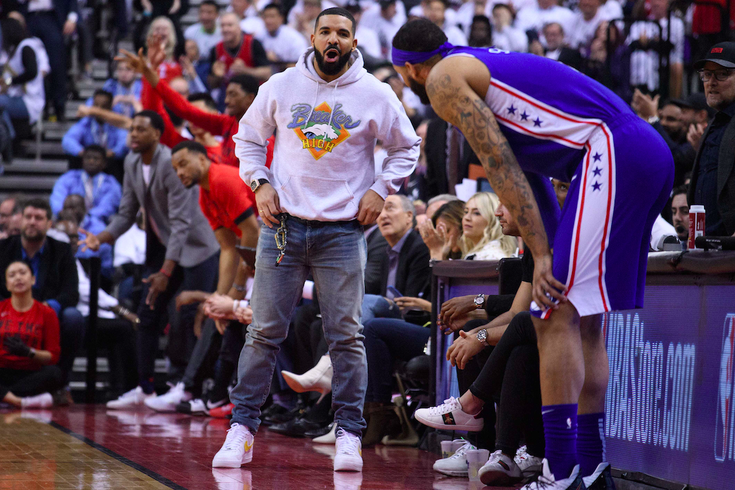
Canadian rapper and Toronto Raptors superfan Drake, is a man who is used to life in the limelight. Typically, that limelight comes from being on a stage in front of an adoring crowd, as you would expect. But recently he has thrust himself onto centre stage at the Toronto Raptor’s NBA play-off game against the Milwaukee Bucks. Within the media, Drake’s antics have received a lot of attention. With particular reference to his unrivalled ability to talk “smack” on the side-line. For example, Professor Adam Earnheardt from the University of Ohio said, “It’s possible that Drake takes some of the pressure off the Raptors by smack talking at opposing players and they can get distracted by yelling back at him.” in an interview for the USA based magazine Fortune. From this quote we can begin to speculate about exactly how Drake is influencing opposing players attention with his distractions. It is reasonable to suggest that in order to retort back to somebody yelling at you, you first need to pay attention to what was said, and second you need to direct attention toward that person to reply. Here in lies a potential key element of the Drake distraction technique. In that, research has built up a pretty substantial claim that the allocation of attention influences performance, particularly under pressure (e.g., Attentional Control Theory; Eysenck, Derakshan, Santos, & Calvo, 2007).
(c) Vaughn Ridley
Attentional Control Theory suggests that we have two systems that influence our attention allocation (Corbetta & Shulman, 2002). First, the goal-directed system, which is concerned with selecting the most important cues from within the visual field and using this information to make the most appropriate goal-related choice. Second, the evil cousin of this system, the stimulus-driven system. When anxiety and pressure are too high, this system can become over activated, somewhat dampening the effect of the goal-directed system. When this over activation occurs, an individual will tend to miss the more important cues and instead focus too much on stimuli deemed ‘threatening’ (perhaps a certain Canadian rapper calling you things you don’t want to be called!). Now, in reality, the stimulus-driven system isn’t “evil”, it serves an important purpose. Moreover, it is suggested that to be at our most successful we need a balance between these two attentional systems (Eysenck et al., 2007). In finding this balance we will be more likely to pick up appropriate cues from our visual field and perform well, while also considering the potential influence of “threatening” stimuli and adapting the game plan accordingly. Empirical research within this area provides support for this assumption. Brimmell and colleagues (2018) reported that individuals who experienced a cardiovascular response associated with positive interpretations of pressure, were able to allocate significantly more visual attention to both the goal area (goal-directed stimuli), and the goalkeeper (potentially “threatening” stimuli) during a pressurised soccer penalty task.
So, could Drake be considered a “threatening” stimuli when viewed through the eyes of an opposing basketball player? It is difficult to answer with utmost accuracy without empirically testing the situation. But it is theoretically plausible. The overt presence of Drake at these games could be leading opposing players to experience an over activation of their stimulus-driven attention system. Following this, players will miss certain visual cues which may lead to misplaced passes or shots as they are no longer fully focused on the task at hand. Indeed, the influence of Drake has not gone unnoticed by players of the team he aims to spur on. Norman Powell (a forward for the Toronto Raptors) was quoted saying “it’s kind of funny how his love and passion for the game and for the team really affected the opponents.” and “you can see that it’s bothering them a little bit.”. The quote advocates that perhaps members of the Toronto team can see for themselves that their opposition are maybe not quite directing enough attention to the game and that the cause of this may be a particular superfan going wild on the side-line.
(c) Nick Turchiaro
To conclude, our attention systems have a big impact on performance under pressure. To be at our best we need to strike a balance between these systems. In certain moments individuals may experience over activation of their stimulus-driven system which will direct attention away from the goal (e.g., winning a basketball game) and instead, direct attention towards the ‘threatening’ stimuli (e.g., Canadian rappers named Drake), resulting in a sub-optimal performance. Also, it appears that certain players on the Raptors current NBA play-off final opponents, the Golden State Warriors, are seemingly unphased by Drake’s actions. Stephen Curry claims to find Drake’s antics “entertaining” – whether this is the case, or if this is reverse psychology to combat Drake, remains to be seen. While the role of celebrity superfan is something that the NBA has come to accept, it’s certainly changed a lot from a calm and collected Jack Nicholson quietly supporting the L.A. Lakers to the current “performances” of Drake. On a personal level, I believe that perhaps the best way to improve as a performer is to perform (or try to) in unique, novel, pressure inducing situations. That being said, it’s as fine line between creating a potential environment for growth and being out-right outrageous in your actions, and I’m not convinced Drake falls the right side of that line. Finally, and taking nothing away from some fantastic performances, the 3-2 series lead the Raptors currently have may suggest the Drake distraction dilemma has not yet been thwarted.
References
Brimmell, J., Parker, J., Wilson, M. R., Vine, S. J., & Moore, L. J. (2018). Challenge and threat states, performance, and attentional control during a pressurized soccer penalty task. Sport, Exercise, and Performance Psychology, 8(1), 63.
Corbetta, M., & Shulman, G. L. (2002). Control of goal-directed and stimulus-driven attention in the brain. Nature Reviews Neuroscience, 3(3), 201.
Eysenck, M. W., Derakshan, N., Santos, R., & Calvo, M. G. (2007). Anxiety and cognitive performance: attentional control theory. Emotion, 7(2), 336.
If you want to find out more about Jack’s work follow him on twitter: @JACKBRIMMELL


 BPS Division of Sport and Exercise Blog