Gaining insights into a coaches thought process through the use of Think Aloud: Perceptions of a High Performance Coach Developer, Jenny Coady.

Jenny Coady, High Performance Coach Developer at UK Coaching, @jennycoady10

Dr Amy Whitehead, Reader in Sport Psychology and Coaching, Liverpool John Moores University, @a_whitehead1

Jenny Coady is currently working as a high performance Coach Developer at UK Coaching, which involves supporting high performance coaches from around the UK in a variety of different ways. Jenny has a background in applied sport and exercise psychology, performance analysis and was an international athlete and uses this knowledge and expertise to develop the coaches she works with. 

Jenny was introduced to Think Aloud at a UK Coaching Coach Develop workshop that Amy delivered in 2018 and discusses how she has taken the tool on board within her practice as a coach developer.

How did you hear about Think Aloud?

I first had a chance to explore the Think Aloud concept at a UK Coaching Coach Developer workshop. It was a thought provoking presentation with a complimentary mix of theory and practical application. It is something that I immediately thought would be useful in my role as a coach developer and of course the performance coaches that I work with. We converse regularly about ‘normalising’ reflective practice so I was excited about the assistance this Think Aloud vehicle could provide

What were your initial thoughts?

It is an easy, adaptable, affordable and self-directed reflective tool. It’s multiple transferable components welcome coaches at all ages and stages of their coaching journey to engage. Knowing the coaches’ previous exposure to reflective tools and understanding their thought process, I was excited to share how this could support and possibly contribute to a deeper understanding. The simplistic and versatile nature of Think Aloud enabled me to introduce it quickly to coaches. The research supporting TA provided a solid foundation for coaches to digest and have clarity on the process. Reflective practice isn’t something that coaches find easy or in some cases a priority, the tool was both accessible and scalable for many coaches enabling them to implement it easily. This, for me, was a chance to change the way we approach reflection and to encourage in-depth reflection in a non-invasive way.

How did you first implement this in your role as a coach and a coach developer?

As a coach developer, I understand that coaching is multifaceted, taking many forms and happening in different environments. Think Aloud presents an opportunity for coaches to initiate the process in their own time, pace and space therefore it becomes bespoke to those coaches who take the time to embrace it. As a group of coaches, additionally we use a virtual platform to share experiences and reflections following the process. Once coaches begun sharing their ideas and experiences they were able to take the next step, exploring the tool further via workshops, lectures and research and implementing where necessary.

If any – how has Think Aloud developed or improved your practice?

Self-awareness and communication were the key areas that immediately presented themselves once the coaches had completed the process. Continued use of the tool highlighted further key areas including; coach-athlete relationships, language and diversion during coaching practice.  TA has refreshed the idea of reflection, a challenging process for many coaches. It has also given me a new insight into a coaches’ thought process and journey that I may not otherwise have seen. One of the interesting questions that Think Aloud has assisted some coaches in discovering ‘How I am being received by others?’. It has given many of the coaches’ confidence, they often feel that the quality, frequency and consistency of reflection has improved. TA has sparked my curiosity to explore reflection in action further, to contemplate and understand where and when it fits in the coaching process best.

If you would like to know more about the use of Think Aloud in coaching and coach development please get in touch with Dr Amy Whitehead via email A.E.Whitehead@ljmu.ac.uk or contact Jenny Coady via twitter @jennycoady10

What am I thinking and feeling? Using Think Aloud within coaching and coach education.

Dr Amy Whitehead, Reader in Sport Psychology and Coaching, Liverpool John Moores University

Sarah Green, Performance Pathway Coach Developer, England Netball

Previously the BPS published a blog by Dr Amy Whitehead, which outlined what Think Aloud was and how athletes, coaches and practitioners could use it. This current blog aims to share the experiences of using Think Aloud, from an applied practitioner. Sarah Green is both a coach and a coach developer and has used Think Aloud within her practice. Sarah’s role is to support the development of coaches delivering within the Netball Performance Pathway, this includes the Vitality Netball Super League Coaches as well as the Roses Academy. Dr Amy Whitehead asked Sarah the following questions about how she was introduced to Think Aloud and how she has used it within her practice:

How did you hear about Think Aloud?

Prior to working at England Netball I worked at The FA. Amy delivered a workshop at one of our development days on Think Aloud. I had never heard about it so I was totally intrigued by the concept and thinking about how I might be able to use it within my then role as a manager and coach educator/developer.

What were your initial thoughts?

After first hearing Amy talk about it I wasn’t sure how it would work for me. It can feel really exposing and leave you a little vulnerable I think if you don’t establish some boundaries for yourself or the person you’re sharing it with. I was concerned about what I would say and if it would just feel like storytelling and therefore become a distraction to my coaching.

How did you first implement this in your role as a coach and a coach developer?

I first used Think Aloud as part of my own coaching practice. I am the first team coach at Derby County Ladies. I’m an A Licence coach so I’ve completed a lot of coach education over the past few years so I was looking for ways that I could develop as a coach beyond those qualifications. I have recently used Think Aloud to support me when I have been delivering a range of sessions that I’ve designed to support the players thinking.

At England Netball I run a coach development programme. Part of the programme is about introducing the coaches to new ideas and concepts that allow them to explore their coaching practice and style. At the October camp I introduced the coaches to Think Aloud. We explored the concept and I shared with them some of my audio before we then had the opportunity to have a go during the court sessions. Away from the programme the coaches have engaged with Think Aloud really well, they regularly send me voice notes from their sessions and I have used the method when observing their coaching on insitu visits.

If any – how has Think Aloud developed or improved your practice?

As a coach I believe it has helped me to continue to stretch and challenge myself in terms of continuing to develop my self-awareness as a coach. I have been able to recognise how I’ve spoken to individuals, how certain reactions from players make me feel and then distract me from my delivery. I’ve found it useful to only have the audio rather than audio and video as I have often got distracted by what I’m doing or the practice. By not having video I am purely focusing on my thoughts and then I can recognise those thoughts again and take different action if required.

I have also used Think Aloud whilst observing the coaches on the coach development programme. I have found it really useful to just say my thoughts out loud and not get distracted by writing things down! The feedback from the coaches has been hugely positive, they have said that they find it really interesting to hear my thoughts throughout the session and how they develop and change as the practices develop. I believe that it gives me an opportunity to share what I’m thinking and feeling in that moment and as things develop I might change my mind or opinion and the audio captures that process.

To find out more about Dr Whitehead and her work follow her on twitter: @a_whitehead1

And read her other DSEP Blog article here: https://bpsdsep.home.blog/2019/04/15/what-are-you-thinking-how-think-aloud-protocol-can-help-us-understand-ourselves-and-our-athletes-cognitions/

Who are the HCPC and Why should I care?

You may have heard the acronym HCPC in recent years or been involved in debates about the HCPC and how they work. But, who are they? And, what do they have to do with us as sport and exercise psychologists?

Who are the HCPC?

The Health and Care Professionals Council are a regulatory body for 16 different health care professions including paramedics, dieticians and practitioner psychologists. This allows for the regulation of practitioners educations, training and practise to ensure that a suitable consistent service provided to the public. The regulation protects the public from practitioners who are not qualified or providing the suitable standard to service.

How does this apply to me?

One of the protected titles under practitioner psychologists is sport and exercise psychologist, this means that to call yourself a sport and exercise psychologist you have to have completed a HCPC recognised qualification and registered with the HCPC. If you use the title ‘sport and exercise psychologist’, or a derivative such as ‘sport psychologist’ or ‘exercise psychologist’ without being qualified and registered, you will be breaking the law and it could result in prosecution.

What’s the fuss about?

Are you wondering why everyone is making sure a fuss about HCPC registration? Without clear regulation many unqualified, unsuitable people could be setting up practises and claiming to be able to provide services they cannot. Which could put athletes at risk, many of whom could be young people. Over recent years the HCPC have been criticised for not properly policing the use of protected titles such as ‘sport and exercise psychologist’ and pursuing prosecutions against those who flout the law. Often this is an area of disagreement; many believe the HCPC should be doing more proactive about seeking out rogue practitioners, whereas others recognise that it is beyond the reach and remit of the HCPC to actively seek out those incorrectly using protected titles.

What can be done about unregistered practitioners?

As members of the HCPC or trainees it is in our best interests to actively protect our title. Many times, you may come across trainees or students using a protected title without knowing that they are not permitted to do so. If you feel it may be a lack of knowledge on the part of the person, it would be appropriate to mention to them the nature of protected titles and regulatory laws. If you feel a persons is knowingly presenting themselves under a protected title they’re not permitted to use or offering services they’re to qualified to provide. The best action to take is to report this to the HCPC directly via a form on their website. (www.hcpc-uk.org/concerns).

For more information about what the HCPC do and how to register as a practitioner check out their website (www.hcpc-uk.org)

Early Specialisation and its Effects on our Children

Emily Pattinson, University of Leeds, @EmilyPatPsyc

Early specialisation within a sporting context is often the subject of discussion, when should youth athletes intensify their training towards elite performance and are there potential implications for their future. Within the ‘Developmental Model of Sports Participation (Côté et al., 2007), early specialisation is defined as the focus and intense training of a single sport with little or no involvement in other activities. A clear distinction needs to be made between participating in a single sport at low or recreational level and early specialisation, which refers to inclusion in high-level focused programmes. 

Many sports coaches see the practise of early specialisation as the most productive way for youth athletes’ to achieving elite performance success. The link between accumulated hours of practise and level of expertise is one of the most robust relationships in behavioural science. Many researchers have used this strong relationship as justification for the practise of early specialisation. One greatly criticised theory at the forefront of this argument is the 10-year rule (Ericsson, Krampe & Tesch-Romer, 1993), a notion that an athlete must accumulate 10,000 hours of deliberate practise to achieve expertise. The accumulation of such a large amount of practise hours before the time of optimum peak performance may only be possible in some sports by the use of early specialisation.

The potential long-term negative effect of early specialisation on youth athletes creates concern for the future of these children.  Early specialisation has been linked with heightened anxiety, low motivation, reduced enjoyment, shorter career length, injury and burnout (Moesch et al., 2011). These effects are caused by the restrictive nature of early specialisation. The lack of opportunities for socialisation outside of the sporting context dramatically reduces the athletes social development, peer acceptance and can have a damaging effect on the child’s developing self-identity. Another common problem with the practise of early specialisation is the high level of adult control. Without parental support youth sport would not be possible, however worryingly, this support can sometimes result in ‘achievement by proxy’ in which the adult knowingly or unknowingly aims to gain personal advancement as a result of the child’s success.  Adult driven control on child athletes can result in increased anxiety and even feelings of guilt following unsatisfactory performance (Knight et al., 2011 ).

One alternative to early specialisation for youth athletes is the practise of early diversification, which refers to the practise of many sports and the use of primarily deliberate play (Côté et al., 2007). Deliberate play is the practise of skills that are inherently enjoyable yet may still contribute to the development of expertise, which is different to the less enjoyable deliberate practise, the repetition of skills designed solely for the development of expertise, seen in early specialisation. Early diversification also encourages the involvement of other sports and activities within a child’s training, up to and even after the specialisation phase in late adolescence.

The negative influence of early specialisation and the inherent positives of early diversification are clear, but what happens when the sport in question requires peak performance before full maturity? When peak performance and expertise are necessary in a shorter time frame, is early diversification possible? Many would argue no. Sports such as gymnastics, diving and figure skating all require an athlete to reach peak performance before the age of 18 years and are know as ‘early entry’ sports. In contrast some studies have suggested a link between early specialisation and peak performance in ‘early entry’ sports. However, qualitative investigation repeatedly highlights the negative impacts on enjoyment and future health that athletes relate to early specialisation.

The ethical question still remains; is a potential link to enhanced performance worth the risk of negative long-term effects on the child’s physical and mental health? There is a need for more in-depth knowledge into the effects of early specialisation and potential alternatives in sports where peak performance is required before full maturation.

References

Côté, J., Baker, J., & Abernethy, B. (2007). Practise and play in the development of sport expertise. Handbook of sport psychology, 3, 184-202.

Ericsson, K. A., Krampe, R. T., & Tesch-Römer, C. (1993). The role of deliberate practise in the acquisition of expert performance. Psychological review, 100(3), 363 – 406.

Moesch, K. et al. (2011). Late specialization: the key to success in centimeters, grams, or seconds (cgs) sports. Scandinavian journal of medicine & science in sports, 21(6), e282-e290.

Knight, C. J., Neely, K. C., & Holt, N. L. (2011). Parental behaviours in team sports: How do female athletes want parents to behave? Journal of Applied Sport Psychology, 23(1), 76-92.

Originally published in The Sport and Exercise Scientist (2016)

Becoming a Sport and Exercise Psychologist

Jo Davis, @JDPsychology, www.jdpsychology.co.uk

Matt Cunliffe,@MattCunliffe24, www.sportpsychologykent.co.uk

The video below is presented by two excellent psychologists Jo Davies and Matt Cunliffe who have both completed the BPS qualification in sport and exercise psychology (QSEP). They will talk about their own experiences of completing the qualification as well as giving existing and potential QSEP candidates tried and tested tips, ideas, and information. This is a must watch for all those starting out on their QSEP journey.

To find out more about QSEP check out the British Psychological Society website

How could we share our research findings with athletic populations?

Alister McCormick, Plymouth Marjon University, @ACM_SportPsych

Think about the intended beneficiaries of your research. How many of this population benefit from your research? How do your research findings get to them? Is there a risk that your research is being wasted, through not getting to them? How would this population prefer to get guidance and information that is based on your research findings?

The sport and exercise psychology community conduct a lot of research. As an applied profession, this research has the potential to benefit a range of athletic populations, including athletes, parents, coaches, practitioners such as sport therapists and rehabilitators, and recreational exercisers. Within these populations, research has the potential to impact outcomes relating to performance, health, injury, wellbeing, and quality of experience. Sport and exercise psychology researchers who want people to benefit from their research need to consider ways of sharing their findings so that people find and then engage with them. The sport and exercise psychology community are generally effective at sharing their research findings within the academic community, particularly through journal articles and academic conferences. So that our findings reach athletic, non-academic populations, it is important to also share findings using ways like websites and magazine articles, and to use different communication styles – Sommer (2006) referred to this as “dual dissemination”.

My own research to date has focused on endurance sports and demonstrated that psychological interventions can benefit the performances of people who participate or compete in endurance sports (for reviews, see McCormick, Meijen, & Marcora, 2015; McCormick, Meijen, Anstiss, & Jones, 2019). Thousands of people recreationally participate in endurance sports competitively and non-competitively, and most of these will not have access to a psychology practitioner who has read my research. I therefore wondered, how should I share my research-informed advice and guidance, in order to maximise its reach and impact?

To answer this question, I conducted a piece of research with Paul Anstiss and David Lavallee (McCormick, Anstiss, & Lavallee, 2018), which aimed to answer the following research questions: How do endurance-sport participants and athletes acquire guidance on psychological aspects of training for, preparing for, and performing in endurance events? And, what are their preferences for receiving psychological guidance? People in the UK (N = 574) who participated competitively or non-competitively in running (5km and greater), road cycling (time trials, road races, or sportives), or triathlon events completed an online survey. The main survey questions addressed how they have intentionally looked for psychological guidance in the last year, how they have got guidance without looking for it, and their preferences for receiving guidance. We found that the most common ways of intentionally finding guidance were looking on websites (48.1% of participants), asking other athletes (46.7%), and asking coaches (32.5%). People most commonly tried to find guidance on coping, motivation, and managing nerves. In relation to finding guidance without looking for it, we found that posts on social media (51.3%), spoken word (48.0%), and magazines (45.9%) were common ways of getting guidance. Other athletes (68.1%) and coaches (40.4%) were most often a source of guidance. Websites (49.5%) and online videos (41.8%) were the most preferred ways of receiving guidance, although others were psychologists working with coaches (35.5%) and event organisers (34.8%), and through reading about findings in magazines (34.7%).

Based on our findings, I encourage researchers to share evidence-based guidance using websites, online videos, social media, magazines, and by working with coaches and event organisers. Research conducted to date offers tips on how to communicate guidance with athletic populations: the language used should be accessible and user-friendly; content should be kept concise and simple; guidance should be practical and made concrete through specific examples, activities, exercises, tools, and materials (rather than just informational content); and downloadable resources such as workbooks and activities are likely to be helpful. These suggestions and other considerations such as required skillsets and media ethics are explored within the journal article (McCormick, Anstiss, & Lavallee, 2018).

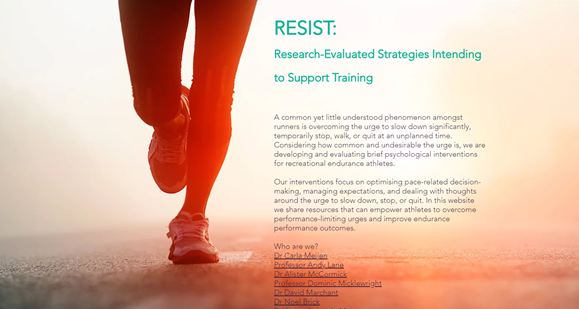
RESIST, a DSEP-funded research working group (which stands for Research-evaluated Endurance Strategies Intending to Support Training) has engaged with these ways of sharing evidence-based guidance on how to overcome the urge to stop, slow down, walk, or quit during endurance events. In particular, we have launched a website that includes evidence-based written guidance and online videos relating to how to overcome the urge to stop, including using psychological strategies such as if-then planning, self-talk, pacing decision making, goal setting, cueing techniques, controlling attentional focus, and re-appraisal (www.resist-stopping.com).

Looking forward to the future, it would be great to see sport and exercise psychology researchers sharing guidance and suggestions based on their research, using ways such as websites, online videos, social media, magazines, and by working with coaches and event organisers. It would also be great to see experimental research testing the effects of interventions that are delivered in these preferable and realistic formats.

For further detail on the study findings check out the full open access paper: McCormick, A., Anstiss, P. A., & Lavallee, D. (2018). Endurance athletes’ current and preferred ways of getting psychological guidance. International Journal of Sport and Exercise Psychology, 1-14. https://marjon.collections.crest.ac.uk/17244/

References

McCormick, A., Anstiss, P. A., & Lavallee, D. (2018). Endurance athletes’ current and preferred ways of getting psychological guidance. International Journal of Sport and Exercise Psychology. https://doi.org/10.1080/1612197X.2018.1486874

McCormick, A., Meijen, C., Anstiss, P., & Jones, H.S. (2019). Self-regulation in endurance sports: theory, research, and practice. International Review of Sport and Exercise Psychology, 9, 235-264.https://doi.org/10.1080/1750984X.2018.1469161

McCormick, A., Meijen, C., & Marcora, S. (2015). Psychological determinants of whole-body endurance performance. Sports Medicine, 45, 997-1015. https://doi.org/10.1007/s40279-015-0319-6

Sommer, R. (2006). Dual dissemination: Writing for colleagues and the public. American Psychologist, 61, 955–958. https://doi.org/10.1037/0003-066X.61.9.955

Using Rational Emotive Behaviour Therapy (REBT) with Triathletes

Dr Martin Turner, Staffordshire University, @DrMJTurner

This blog will introduce Rational Emotive Behaviour Therapy (REBT) and present a summary of a recently published paper exploring the use of REBT in triathletes.

What is REBT?

REBT is a second wave cognitive behavioural therapy (CBT) which focuses on supporting people to challenge and change irrational beliefs, and adopt rational beliefs instead. At the core of REBT is the belief premise that rational beliefs that are flexible, logical, and non-extreme lead to psychological health, whereas irrational beliefs that are rigid, illogical and extreme lead to psychological distress. There are four types of rational and irrational beliefs within REBT.

  Rational Beliefs Irrational Beliefs
Primary Preferences
“I want the coach to be fair to me, but they don’t have to be”  
Demandingness
“I want the coach to be fair to me, and therefore they have to be”  
Secondary Anti-awfulizing
“It’s really bad, but not
terrible, if the coach is not fair to me”  

High frustration tolerance “It would be difficult, but I
could bear the coach not being fair to me”  

Self-acceptance (acceptance of others and the world)
“The coach not being fair to me does not mean that they are completely bad and
damnable”
Awfulizing
“It’s not just bad, it’s terrible if the coach is not fair to me”    
Low frustration tolerance
“It is too difficult, and I could not bear the coach not being
fair to me”

  Self-depreciation (depreciation of others and the world) “The coach not being fair to me shows that they are
completely bad and
damnable”

How did we explore REBT with Triathletes?

Triathletes were screened for their irrational beliefs. Those with sufficiently high irrational beliefs (n = 24) were selected to take part. Then participants were systematically and alternately allocated to one of two groups; Group 1 received group Rational Emotive Behaviour Therapy (REBT) education, followed by a Rational Emotive Personal-Disclosure Mutual-Sharing (REPDMS). Group 2 received group Rational Emotive Behaviour Therapy (REBT) education, followed by a PDMS session, rather than a REPDMS session. Irrational beliefs and self-determined motivation were measured throughout the intervention, from baseline to post-intervention. Results indicated that REBT education was effective in reducing irrational beliefs, and increasing self-determined motivation. However, at the onset of REPDMS and PDMS, irrational beliefs increased toward baseline both groups, whilst self-determined motivation remained elevated. Data suggest that the REPDMS session had no meaningful effect on irrational beliefs over and above REBT education, but did have a maintenance effect on self-determined motivation.

To find out more check out the full paper written by Dr. Martin Turner and Helen Davis:

Turner, M. J., & Davis, H. S. (2018). Exploring the effects of rational emotive behavior therapy on the irrational beliefs and self-determined motivation of triathletes. Journal of Applied Sport Psychology, 1-20. doi: 10.1080/10413200.2018.1446472

Or check out the project website: https://thesmarterthinkingproject.com/blog/

If you want to learn more about how to use REBT have a look at our REBT CPD event on Wednesday 9th October 2019:

https://www.bps.org.uk/events/application-rational-emotive-behaviour-therapy-rebt-sport

FIFA Women’s World Cup: When the favourites don’t slip up!

(c) Anna Gowthorpe/BPI/Shutterstock

Rebecca Chidley (CPsychol) @life_in_sport

It goes without saying that sport provides us with some competitive mismatches. When looking for examples of these it is difficult to look past the FIFA Women’s World Cup currently taking place in France. There is a long way to go in the World Cup but these types of events give us numerous instances of underdogs vs competition favourites. Just this week the USA have beaten Thailand 13-0, with the USA receiving lots of criticism for their approaches. But if you are amongst the favourites to win a competition don’t you want to stamp your authority and gain the advantage over your rivals. The issue is that everyone loves an underdog story so when the favourites get the job done the media have to look for an alternative story.

What do we know about underdogs and favourites?

The very nature of sport means that groups and individuals are in direct competition with each other. From this we are very aware that there are expectations around who will win and lose. These expectations can be based on formal rankings, prior outcomes or differences in ability or resources.

The terms underdog and favourite have been used in several disciplines to describe such instances of clear competitive expectations towards certain outcomes. Common among them is a general definition of underdogs as those who are expected to lose, whereas favourites are expected to win (Kim et al., 2008).

Every sporting scenario provides an example of competitors showing a strong desire to come out on top. However, individuals or teams can approach situations in different ways in relation to their orientations, motivations or goals (Ten Velden, Beersma, & De Dreu, 2009). Favourites and underdogs approach competitions with different motivational orientations which begin with the differing expectations that are held for each. Indeed, the labels underdog and favourite are laden with the very expectations they describe (i.e., to lose and to win respectively) and it is well established that people are sensitive to, and internalize, the expectations that others hold for them (Steele & Aronson, 1995).

(c) Ron Chenoy-USA TODAY Sports

More on the Favourites…

• The favourites often have little to gain by winning (as we have seen from the USA scenario), as the outcome meets existing expectations but in stark contrast they have much to lose if they are outperformed by the underdog.
• The goal of winning is seen as a minimum standard that must be met, and as such, winning becomes an obligation or duty that favourites ought to fulfil to secure their standing (Higgins, 1998). When winning is viewed in these terms, people translate the goal of winning (a positive outcome) into a focus on not losing (elimination of a negative outcome) (e.g., Molden, Lee, & Higgins, 2008).

More on the Underdogs…

• Underdogs are, by definition, expected to lose. As such, they have little to lose but much to gain if they perform better than the favourite.
• Underdogs may feel that winning when a loss is expected will cast their group in an especially positive light, whereas losing will come with few costs because it matches expectations (again with Thailand losing has come with little cost).
• The goal of winning is seen as a maximum standard that one hopes to achieve, and as such, winning becomes an aspiration or an ideal for underdogs to advance their standing (Higgins, 1987). When winning is viewed in these terms, people should be primarily concerned with obtaining a desired positive outcome.

What helped the USA to be particularly effective against Thailand?

  • Manage the expectation – How a team manages the label of ‘favourites’ is key in the build-up to a match. This is something that the USA would be familiar with based on their successful past but when you are building through the phases to retain the world cup this expectation can become overwhelming.
  • Do the basics well – Often when a team is labelled as favourites, they begin to overcomplicate things. The USA stuck to doing the basics well and used their experience really effectively. Working as a team and enjoying the process.
  • No Complacency – It is very easy in these situations to become complacent and lose focus on what you need to do to get the job done. Often teams and individuals assume they have the result before they do! The dangerous “we ‘should’ win” phrase that we hear bounced around in sport. Yes, the USA should beat Thailand but the focus on the process of ‘how’ they will do it is key.

Final Thoughts…
Not every competitive mismatch will see a team like the USA win so comfortably, there will be times when the Underdogs achieve the unthinkable, Every, athlete will face a challenge where they are either seen as the underdog or favourite. How that expectation is managed will be key in breaking down the processes and performance to get the desired outcome.

Despite much of the negativity that has surrounded the USA we need to remember is this is a World cup so of course you will celebrate every goal and be ruthless in your approaches to that. What is does do is remind us of the gulf in resources and funding in women’s football throughout the world. Despite the positive steps forward in some countries it is still a growing sport on the world stage.

Reference List

Higgins, E. T. (1987). Self-discrepancy: a theory relating self and affect. Psychological review94(3), 319.

Higgins, E. T. (1998). Promotion and prevention: Regulatory focus as a motivational principle. In Advances in experimental social psychology (Vol. 30, pp. 1-46). Academic Press.

Kim, J., Allison, S.T., Eylon, D., Goethals, G.R., Markus, M.J., Hindle, S.M., & McGuire, H.A. (2008). Rooting for (and then Abandoning) the Underdog.

Molden, D. C., Lee, A. Y., & Higgins, E. T. (2008). Motivations for promotion and prevention. Handbook of motivation science, 169-187.

Steele, C. M., & Aronson, J. (1995). Stereotype threat and the intellectual test performance of African Americans. Journal of personality and social psychology69(5), 797.

Ten Velden, F. S., Beersma, B., & De Dreu, C. K. (2009). Goal expectations meet regulatory focus: How appetitive and aversive competition influence negotiation. Social Cognition27(3), 437-454.

Online support and learning opportunities: Valuable features in the athlete/performer world

Dr Olivia Hurley, Dun Laoghaire Institute Of Art Design + Technology, @DrOliviaHurley, Author of Sport Cyberpsychology

While the online world has come in for, perhaps, some justifiable criticism in recent times, it would be an injustice to vilify the benefits the online world offers to many individuals too, especially in the domain of sport and performance. Athletes and performers across many disciplines, and levels of performance, use the online world frequently because it is a valuable resource for them, for so many reasons, including: (i) to be inspired, (ii) to discover new information, (iii) to remaining in contact with others and (vi) for entertainment purposes (Hurley, 2018).

The Internet enables athletes (coaches and spectators too) from all over the world to view what others in their fields of performance or interest are achieving. It can inspire them to raise their own standards in order to match, and perhaps even supersede, such accomplishments. One of the basic principles of human learning is that of modelling the behaviour of others (Bandura, 1977). That is, individuals often learn by mimicking or copying what they see other individuals doing. In sport and performance settings, this is no different and online, visually/video-based, platforms such as You Tube, as well as social media outlets such as Facebook, Twitter and Instagram, allow activities to be recorded, uploaded and watched repeatedly, until that behaviour or skill being performed has been mastered (Boschker, & Bakker, 2002; Boyer, Miltenberger, Batsche & Fogel, 2009). Before the online world, such behaviours often needed to be witnessed in person or were recorded with devices much less transportable that today’s ipads or smartphones, in order for them to be learned, replayed and mastered by others. The online world has remove such inconveniences.

The online world also provides individuals from various sport and performance communities, including coaches and officials, with invaluable opportunities to advance their knowledge-base or to ‘up-skill’ (Hurley, 2018; Leinster Rugby, 2017). Online learning platforms such as Blackboard and Moodle, for example, allow education and coaching programmes to be offered to all kinds of students, with all kinds of backgrounds and specific needs. One of the main, and obvious, advantages of such online learning is that it removes the barriers of location (Kreb & Lockee, 2009). Therefore, a person in nearly any part of the world with Internet access today, can potentially study any discipline not offered in a traditional, on-campus, setting within their own geographical location. Not only does this present individuals with new and exciting learning opportunities for up-skilling their current mastery level, it also generates significant revenue for the institutions offering such online learning programmes, in a very cost-effective way (because lower overhead costs are incurred in the running of such programmes, by using online delivery methods).

The online world also offers many opportunities for like-minded individuals to communicate with each other and support each other in ways not possible before the creation of the Internet. For example, today, injured or retiring athletes and performers across the world often receive hundreds, if not thousands, of messages of support via their social media networks when they are often in greatest need of such important support (Bejar et al., 2017). Periods of rehabilitation and career transition or retirement can be physically and mentally challenging for many people. Supported athletes and performers have spoken publicly in the media about the importance of such social support in helping them to manage those difficult times (The 42, 2017). They have frequently commented how the support they received helped them to remember they are members of special communities. Such awareness may have been forgotten by such individuals in the years before the Internet was created.

One also should not forget that athletes and performers are individuals and people first, before considering what they do in life as a career. The online world enables members of the wider public to see that such people have other interests and hobbies, fun, family, and friendships outside of their careers and public personas. Before the online world, such in-depth information and knowledge was not available to the general public (Hurley, 2018).

So, as stated at the start of this article, while the online world has come in for some justifiable criticism in recent times, it would be an injustice to vilify the benefits the online world offers to many individuals, especially in the domain of sport and performance.

Reference List

Bandura, A. (1977).Social learning theory. Englewood Cliffs, NJ: Prentice Hall.

Bejar, M.P., Fisher, L.A., Nam, B.H., Larsen, L.K., Fynes, J.M., & Zakrajsek, R.A. (2017). High-

level Korean athletes’ experiences of injury and rehabilitation. The Sport Psychologist, 31, 16-29. 

Boschker, M. C. J., & Bakker, F. C. (2002). Inexperienced sport climbers might perceive and

utilize new opportunities for action by merely observing a model. Perceptual and Motor Skills, 95, 3–9.

Boyer, E., Miltenberger, R.G., Batsche, C., & Fogel, V. (2009). Video modeling by experts with

video feedback to enhance gymnastics skills. Journal of Applied Behaviour Analysis, 42, 855-860.

Hurley, O. A. (2018). Sport Cyberpsychology. London: Routledge. 

Kreb, S.G., & Lockee, B.B. (2009). Supporting student-athletes through distance learning: a

game plan for success. Paper presented at the 25th Annual Conference on Distance Teaching and Learning.

Leinster (2017). Leinster Rugby continues collaboration with St. Mary’s University,

Twickenham. Retrieved from: http://www.leinsterrugby.ie/leinster-rugby-continues-collaboration-with-st-marys-university-twickenham/.

The 42. (2017). Jockey Mark Enright on how he overcame depression. Retrieved from: https://www.youtube.com/watch?v=jmsD79Mu9zw

LGBTQ+ Awareness in Sport Psychology Research and Practise

Dr Emily Pattinson, University of Leeds, School of Healthcare, @EmilyPatPsyc

In summer 2016 the Great British Olympic team were praised as being one of the most diverse teams at the games, with 11 openly LGBTQ+ athletes across the Olympic and Paralympic teams. GB equestrian star Lee Pearson literally waved the flag for LGBTQ+ athletes after he was given the honour of being the GB flag bearer at the Paralympic opening ceremony. Other trailblazing LGBTQ+ athletes such as diver Tom Daley, boxer Nicola Adams, race walker Tom Bosworth and hockey players Kate and Helen Richardson-Walsh have all raised awareness for LGBTQ+ athletes.

Sadly not all stories from LGBTQ+ athletes are positive, with many athletes suffering as a result of homophobic and transphobic attitudes in sport. This is supported by the findings of the Sport England Pride sports document (2016) in which it was suggested LGBTQ+ equality is see as less important when compared to other minority group equality, such as race or disability. It was also suggested that there is an overall lack of knowledge of LGBTQ+ issues and how to address homophobia and transphobia in GB sport.

No matter your personal feelings towards LGBTQ+ athletes in sport, shouldn’t every athlete feel safe, respected and valued in their sport? The first step to increasing awareness and reducing homophobia and transphobia in sport is to have an open discussion and increase our own knowledge. Here are a few little changes we can make as practitioners, researcher, coaches and humans to help make LGBTQ+ athletes feel welcomed and valued.

Sex and Gender are NOT the same

Gender is often used as an umbrella term for biological sex and gender identity, but they are not the same thing. An easy way to remember this is that biological sex is what you have between your legs, of which there are three options: male, female and intersex. Whereas, gender is what is between your ears, and there are endless options. Gender is a self-expression which sometimes does and sometimes does not match your biological sex. For example, someone who is non-binary may not identify as entirely male or entirely female but this has nothing to do with the biological sex they are.

Try to avoid assuming someone’s gender. A good trick to avoid any upset or uncomfort is to ask someone what pronoun they would like to be referred by: he, she or they. Also many people who are gender diverse may not feel comfortable trying to fill in a survey if the gender options are male or female. Try offering an open text option for gender on forms that way you get the most accurate demographic information and everyone feels valued. These little things can make a huge difference when building a rapport with an LGBTQ+ athlete.

Avoid Heteronormativity and Cis-normativity

Heteronormativity is the belief that heterosexuality (being straight) is the only and right sexual orientation, and cis-normativity is the belief that male and female are the only genders. By making an assumption that someone is straight you could be dismissing a part of that person they are very proud of. Try using gender neutral terms like partner instead of wife or husband, and child instead of son or daughter. A little change but it can make all the difference.

Put yourself in Other People’s Shoes

The best way to combat homophobia and transphobia in sport is to imagine someone said that about you. You would be surprised how many passing comments can be so hurtful. To use an example from my own work, I was informed of an incident in which one youth athlete had made a comment that another youth athlete that their upbringing was poor because they had two mums. If that young person’s mother was disabled no one would question that comment was inappropriate. However in this instance the young person was told by certain coaching staff that they should expect that sort of comment as their parents relationship was not the norm. Should anyone have to expect abuse and inappropriate comments because of something out of their control? Watch the video linked below, it’s a great little video demonstrating what it would be like if homosexuality was the norm and heterosexual people were persecuted and targeted (Warning: some viewers may find the video upsetting, scenes of bullying and self-harm), it’s a fantastic illustration of little comments that are often missed. Especially watch out for the comments made by the teachers, and ask yourself have you ever made a comment like that?

By clicking and reading this short article you have made the first step towards combating homophobia and transphobia in your practise, thank you.

Imagine A World Where Being “Gay” The Norm & Being “Straight” Would Be The Minority! https://www.youtube.com/watch?v=CnOJgDW0gPI

If you would like any more information or advice on LGBTQ+ inclusivity in your practise, research or coaching contact Emily: e.m.pattinson@leeds.ac.uk